Eli and Evelyn are back in this sequel to Boychik, publishing in early 2027.
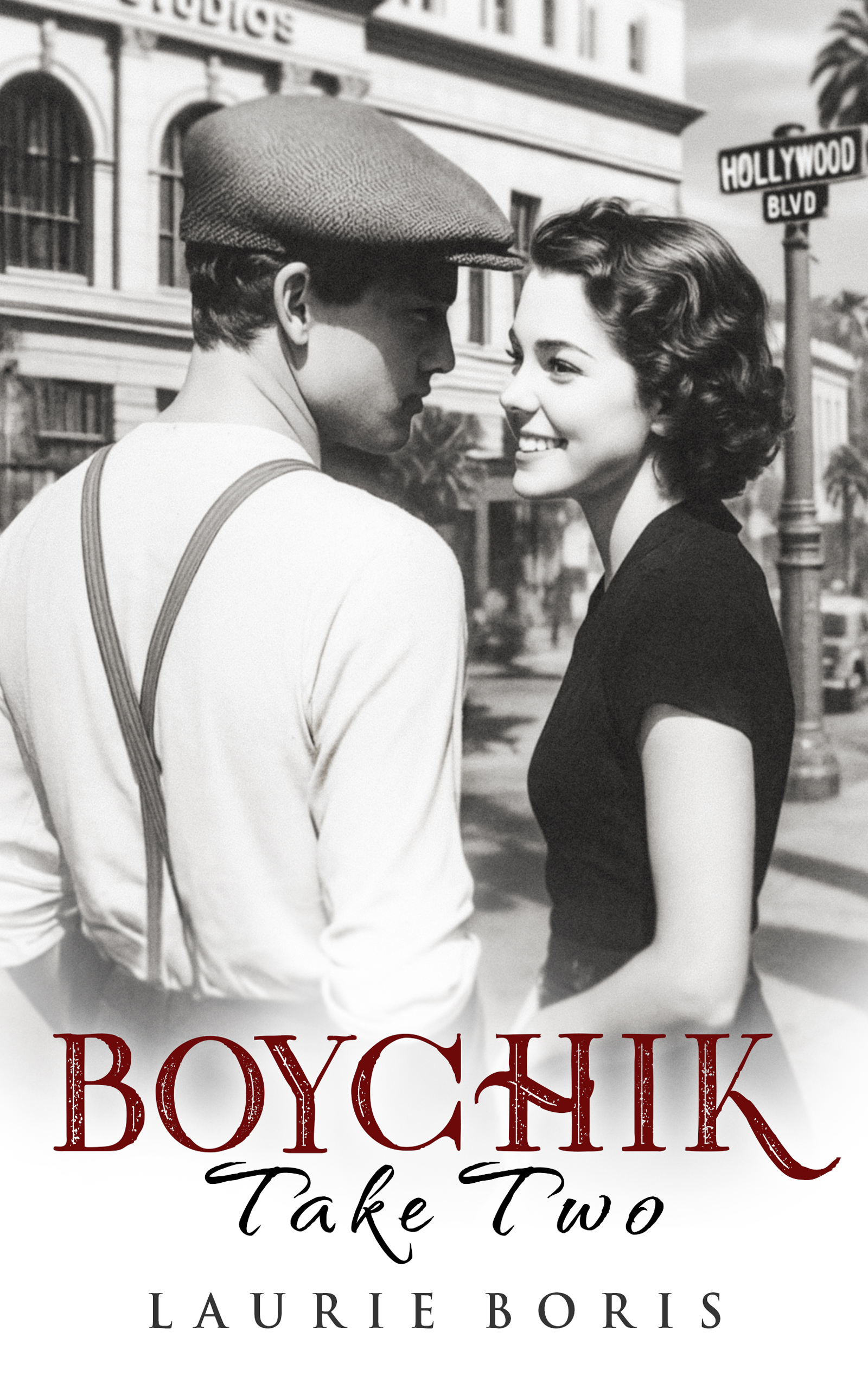
Hollywood, 1933: A mobster’s daughter. A deli-man’s son. A new city. An old problem. Evelyn and Eli think they’ve left their troubles behind in Brooklyn. But in a city built on reinvention, there’s always a catch. Ghosts from their pasts—secrets, betrayals, people they’d rather forget—are never far behind. In a town where everyone has a story, the one that catches up with them might be their own.
Read a sample here!
Chapter 1
Los Angeles, January 1933
Eli dabbed a straw into the puddle of Fox’s U-bet syrup at the bottom of his egg cream glass. At home in Brooklyn, when it was just him and his cousin Artie, they’d wheedle an extra spritz of seltzer out of the counterman at this point, to make the chocolate last longer.
But Los Angeles wasn’t home—he’d arrived all of a day and a half ago for a meeting at Warner Brothers—and he didn’t know the rules. Also, seeing Evelyn again had knocked him sideways, a position from which he’d yet to recover.
“You’re quiet all of a sudden,” she said.
“I could say the same for you.”
She put on a smile that shivered him from his unruly hair to the worn heels of his plain brown oxfords. “Just thinking.”
“I’m afraid to ask what.” If this was a movie, he’d slide a little closer and stare longingly into her eyes. But that would have been hard to do sitting on side-by-side diner stools.
“I’m thinking,” Evelyn said, “that you and I have yet to have a real date.”
He considered that, and before he could speak, she continued, ticking off incidents from their brief history on her fingers. “We became acquainted back in Brooklyn, spent some time together at the Greenpoint synagogue and then in your father’s basement, and although you were the best of company a young woman could imagine having in such a predicament, that’s as far as it went.”
He felt heat race to the tips of his ears, remembering what had happened at the Greenpoint synagogue all those months ago—another basement story—and how, in all truth, he hadn’t wanted to stop kissing her. He cleared his throat. “Well, to be fair, you were engaged to someone else at the time.” Someone who wanted to kill me.
“To be fair, that’s true. But things are different now.” Her eyes gleamed. “I know where we could go.”
He put down a quarter for the counterman and followed her out. Soon they were in the Warner Brothers parking lot. Still, she wouldn’t tell him where they were going. They walked a few rows in, and she stopped next to a sporty-looking Ford Roadster. He couldn’t make himself move. He hadn’t seen her since she left Brooklyn last spring; mere hours earlier, Jack Warner himself had offered Eli a writing job, and he still couldn’t shake the disorientation that those two facts produced. “You have a car?”
She shrugged. “It’s my boss’s car. She lets me borrow it from time to time, if I’m good. One of the perks of being her favorite script reader, I guess. Get in.”
He got in. “When did you learn how to drive?” Last he’d seen her, she was eighteen, same as him, but while he drove his father’s delivery van, she was squired around town by the family chauffeur, a man you didn’t want to mess with if you knew what was good for you.
Evelyn gave him a beguiling smile. “A woman has to have some mystery.”
She turned out to be very good at driving, and the sights and sounds of Sunset Boulevard approaching dusk took most of his attention. She stopped at a red light, pulled a blue cotton scarf from her pocketbook, and waved it at him.
“Put this on,” she said. “Like a blindfold.”
“What?”
“I want this to be a surprise.”
“But I—”
“Do you trust me?”
“Of course I—” Did he? Did he really?
“Oh, for Pete’s sake, boychik. Put it on.”
He put it on. He felt the car accelerate through the intersection, turn right a few minutes later, then stop. “Wait there,” she said. “I’ll guide you.”
He opened the door, and by the time he’d gotten to his feet she’d taken his arm.
“Step up here,” she said, and he followed. He followed all her directions—another step, through an open door. He smiled as the aromas hit. Vinegar. Dill. Garlic. She took off the blindfold, most likely knowing he’d figure out where they were as soon as they stepped inside.
Shortly after they’d found a table and ordered from the earnest young waiter who had no trace of a Brooklyn accent—something Eli had a hard time digesting—their meals arrived. Even from a glance at the plate he could tell that it wasn’t the pickles and pastrami and coleslaw he remembered from back east, the food that had seeped into his life and his home and his body, but after his first bite, he had to admit that it wasn’t half bad.
Evelyn said, “It’s not your father’s deli, but it’ll do.”
Then she smiled. And he smiled at her smile. In that moment he thought he might be falling in love with her. Had he been in love with her back in Brooklyn? Surely he’d felt an attraction, from the moment they met. He’d had a definite physical desire—even before they kissed in the temple basement last spring when his family catered an event she’d helped organize—and a wistful longing when she disappeared from his life. He’d been afraid and worried for her because of her family troubles, and he was still in shock that once again their paths had crossed.
But was it love? In truth, he knew very little about love and even less about her—aside from those family troubles. Just that she was pretty and smart and quick-witted and well, a little forward, as his aunt might say, but he didn’t mark that against her. He could be slow at making decisions, defaulting to a deliberation that was partly based in fear of making the wrong choice. His cousin Artie was the first person to notice that about him. In fact, he’d defined it, one afternoon when they—mostly he—were waffling over which film to spend their precious quarters on.
“You’re thinking that the western might be better than the Cagney,” Artie had said. “Whereas if you spend any more time deciding, we’ll miss them both.”
“You’re right,” Eli said. “Why are you always right?”
“I’m sorry, what?” Evelyn said, batting her eyes. “What am I right about now?”
He laughed to cover his embarrassment, but as always, the tips of his ears gave him away. “You’re right that it was a good idea to come here. It’s comforting to have a taste of home. Of course, I would have added more peppercorns to the pickle brine…”
“Of course,” she said, enjoying another mouthful.
“Maybe sliced the pastrami a bit thinner…”
“No doubt.”
“Added a little more celery seed to the coleslaw dressing.”
The way she looked at him with that little pout made him nervous again, and he continued. “I mean. It’s good. I’m not saying it’s not good. I’m saying…well, I’m not sure what I’m saying.”
She nodded. “You’re saying that it’s good, but it’s not yours. It’s okay. I understand completely. Every cannoli I eat here pales in comparison to the ones I used to get from the Italian bakery in Greenpoint. Nothing is like home. But that’s a good thing.”
He cocked his head in question. “Evelyn, I’m not sure I—”
“Paula,” she said.
“What?”
“Paula Gold.” She lowered her voice. “It’s the name I go by here. In public. Long story short, it’s safer that way.”
Paula Gold. This intrigued but troubled him. At the lengths she’d had to go through to leave Brooklyn. And for Brooklyn to leave her alone.
“Anyway,” she said. “Sometimes it’s good to put ‘home’ in a little box in your mind and let yourself move forward. To a new ‘home.’”
“That’s why you’re Paula Gold now.”
She shrugged.
So that’s what you did after you left, he thought. Changed your name, put your goniff father and chauffeur and fiancé—ex-fiancé—in a box and closed the lid? Could it really be that easy?
They said little after that, aside from commentary about the food and the weather and the beauty of the landscape. They said little on the drive back to Warner Brothers.
He couldn’t yet call Los Angeles home, no matter what box he put it in.
An awkwardness filled him as they got closer to the studio. Would she drop him off in the parking lot and let him get a streetcar back to his hotel? Should he see her back to her place? He didn’t know where she was living other than a vague nod to the east.
“Where are we going?” she asked, her words flowing into the silence like warm water.
Anywhere you want. But he couldn’t say a thing like that to a girl like her. Artie would say…he would say… “Darned if I know.”
She laughed. “I meant, am I taking you back to your hotel? It’s been a long day for you, but one mustn’t ever assume.”
Clever words again evaded him. “Sure,” he said finally. “I mean, I—sure.”
After winding through streets dotted with service stations and diners, movie theaters and rooming houses, she stopped in front of the hotel where he was staying on Jack Warner’s dime. He glanced over at her, noticing again how sophisticated she’d become since leaving Brooklyn. Her hair was different, still brown and softly curling but with an insouciant wind-blown starlet look. She had always been fashionable, but there was something more grown-up in the way she presented herself. Paula Gold worked for Warner Brothers and she could drive and knew the roads and where to find the best deli in town.
And here he was, Eli Abramowitz, fresh off the train from Brooklyn, from his father’s house. He could still smell the lox and pastrami and pickles on his hands.
Had she outgrown him? Was she out of his league, only he hadn’t known it at the time?
What did he really know about her at all?

